“Your compositions are a brilliant reflection of the evolution of jazz over the last forty years, retaining the essence of the jazz tradition but at the same time taking the music forward!”
From the CD “The Dobson-Jones Historic Recordings”
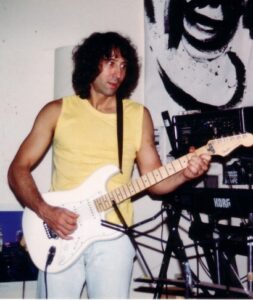
Composed by Mark & Cathy Dobson, arranged by MJ, lead guitar, keyboards, vocal harmonies MJ, bass Mat Petterson, drums Kevin Hart, vocals & acoustic guitar Mark Dobson
Sephardic Dance by Mark Jones performed by Arturo O’Farrill’s Afro-Latin Jazz Orchestra in 2025
Introduction
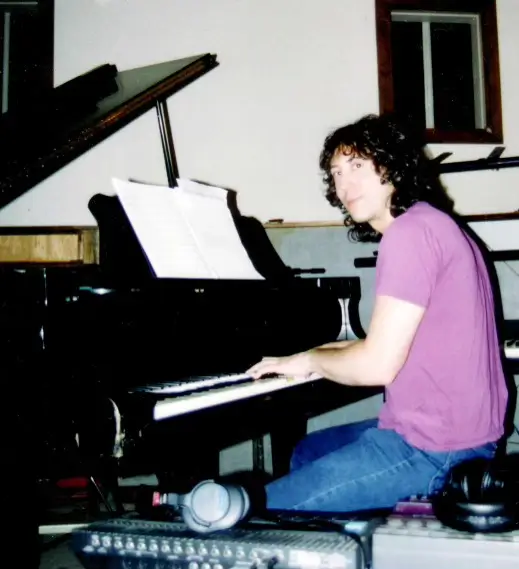
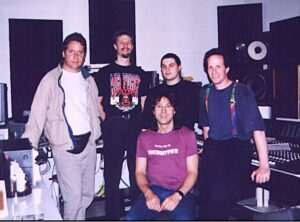
MJ in recording studio, NYC 1993
Mark Jones is a distinguished composer, jazz piano improviser and producer. A reclusive artist who rarely performs in public or on recordings, Mr. Jones is one of the few contemporary musicians who possesses a completely original piano style and has authored a book of truly memorable, engaging compositions that serve as new standards for improvisation. He has also composed various classical works, music for theater, and has taught in universities and privately. In addition to being a composer and pianist, he also has performed professionally and recorded on both the guitar and harmonica.
College
In his first year of college, at the University of Miami, he bought his first real guitar – a Martin D18, and worked on blues, rock and especially country rock. The next year, he transferred to Kent State University, where he became very interested in jazz after hearing records by John Coltrane, Cecil Taylor, Oscar Peterson, Chick Corea, Pharoah Sanders, John McLaughlin, Larry Coryell and others. Being primarily a classically trained painter, Mr. Jones decided to attempt to translate his abstract visual stylings into sound on both piano and electric guitar. While still at Kent State, he formed the Cleveland Art Ensemble with some friends and other musicians to perform works by Keith Jarrett, Herbie Hancock, Miles Davis, Larry Coryell, Joe Farrell and his own originals. He continued to teach himself piano, guitar, arranging, and also studied Indian ragas and African rhythms.
Musical Studies
Jamming with Sonny Murray on drums and Jimmy Lyons (not pictured), with Cecil Taylor looking over his shoulder, Woodstock, NY 1980
After college, Mark decided to make up for lost time and study with as many of the best teachers as he could. He studied composition and harmony with Daniel Altsman, and while living in Youngstown, Ohio he studied jazz and classical piano with Sidney Jireck. He also began composing more in the jazz idiom. One evening he replaced the guitarist backing the Drifters. In 1977, he moved to New York and studied with bebop master Walter Bishop Jr., a living link to Charley Parker, Miles Davis and Bud Powell, and even sat in with Bishop’s group playing the knuckle-buster “Cherokee.”
The following year, Mark moved back to Cleveland and studied classical piano with the Lithuanian virtuoso Antanas Smetona, while he was also writing quite a bit of jazz and classical music. He, roommate Jeff Stewart and saxophone virtuoso Phil Capone had a jazz workshop in their living room, even holding big band jam sessions. Mark was commissioned to write a Prelude and Fugue for Woodwind Quartet and Men’s Choir by Case Western Reserve University, and it was performed to much acclaim in Cleveland. In 1980, Mark had the opportunity to study with Cecil Taylor and his band at the Creative Music Studio in Woodstock, NY. Mark performed one of Cecil’s works on piano with an orchestra, and was pictured with Cecil in Downbeat Magazine. Six months later, he gave a solo piano performance at Spaces in downtown Cleveland, which was recorded and later transferred to CD.
Shortly thereafter, Jones moved back to New York in order to study with Sal Mosca, one of the most accomplished jazz pianists and educators in the world who had been regarded as Lennie Tristano’s successor. Mark studied with Sal for 7 years, while concurrently studying conducting, orchestration and classical piano at the Westchester Conservatory in White Plains.
New York
Around that time, he also formed his first version of his band, Sound Sculpture, with Kevin Hart on drums and Matthew Petterson on bass which was formed in order to perform Mark’s original compositions. They played a few gigs and Mark also played several piano/bass duets with a number of bass players at Dudley’s in Ossining. He also had his Quartet for Oboe, Two French Horns and Cello performed in New York City. MJ with Sound Sculpture (2nd lineup), NYC recording studio, 1993. L to R: Rob Thomas, Jon Doty, Jay Mazzarella, Steve Samuels
In the 1980s, Mark met a rock musician named Mark Dobson, who wrote rock songs with his wife Cathy.
They formed a friendship and played some local gigs together and did some fruitful recordings both in New York and in Orlando, Florida with Mr. Jones producing the sessions and playing multiple instruments, including plenty of flashy lead guitar and piano. A few years later, the second version of Sound Sculpture was formed with bassist Jay Mazzarella and drummer John Doty. They played a few gigs and recorded 3 tunes in Manhattan with the addition of violin virtuoso Rob Thomas who had just moved to New York from Oregon and percussionist Steve Samuels.
In 2005, Mark began his BossAmerioca project, an attempt to record American and English tunes from the 60’s that had been influenced by the Brazilian bossa nova craze, and to perform them in a pure Brazilian bossa nova style. The EP was recorded with featured vocalist Debby Santos Watts and it was widely praised by some of the originators of bossa nova, such as Roberto Menescal, Marcos Valle, Carlos Lyra, Cesar Machado, the music director for Maria Creuza, and Carlos Afonso, the director of Toca do Vinicius, the major bossa nova record store and museum in Rio.
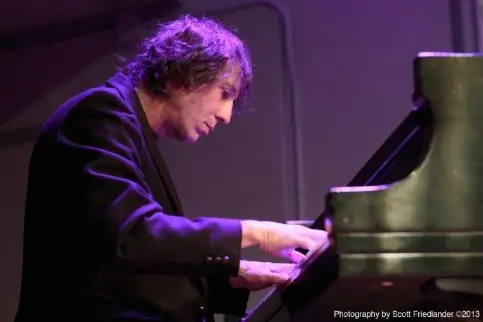
Solo performance at Roulette Theater, Brooklyn, March 27th 2013
The EP was played as house music in the foremost bossa nova club in Rio, the Vinicius Piano Bar. In subsequent years, Mark has composed experimental electronic music, music for theater and websites, classical works and new standard tunes for improvisation.
Mark Jones’ music is freshly innovative, uncompromising, virtuosic and poetic, with traces of influence found in such varied sources as Ornette Coleman, Cecil Taylor, McCoy Tyner, Bud Powell, Paul Bley, Sal Mosca, Charlie Parker, Thelonious Monk,
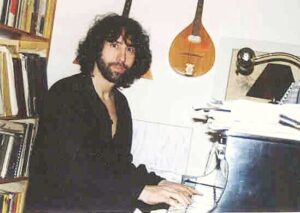
Composing at home on Steinway grand, Cortlandt Manor, NY early 2000’s
John Coltrane, Debussy, Prokofiev, Scriabin, Brahms, Bach, Bartok, the 12 tone serialists, 60’s folk and rock, and world musics, especially those of Spain, India, and Brazil, where he had spent winters for over 20 years.
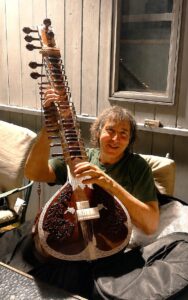
He also has long developed a sideline of intense interest on acoustic guitar in the folk-baroque style as exemplified by Bert Jansch, John Renbourn, Davey Graham, and others, as well as his continued interest in delta blues and ragtime styles.
Twenty-First Century
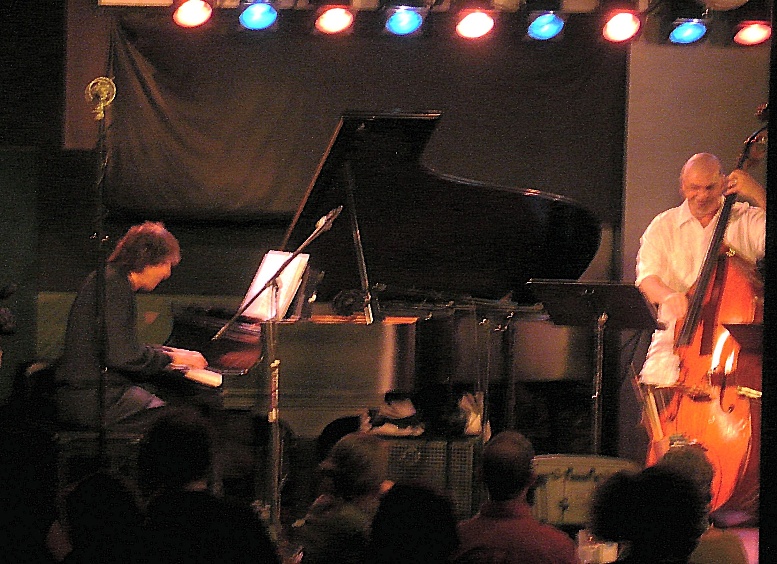
Iridium Club, NYC, July 29th 2009
On July 29th, 2009, Mr. Jones gave an acclaimed concert performance with his third incarnation of Sound Sculpture at the Iridium Jazz Club in NYC with Rob Thomas, Ken Filiano, Jay Rosen and Joe Cruz. A CD and DVD of the performance was released in August of 2010. A few years later, Jones performed a solo piano piece at Brooklyn’s Roulette Theater as part of a memorial concert for British uber-jazz fan Peter Cox that featured an all-star lineup of NY jazz musicians.
Mark has been working on publishing his book of music compositions for improvisation that will include reference CDs of the melodies and is intended primarily for use by musicians to provide fresh, melodic compositions to their repertoire. Already one piece was performed by first violinist in the Dallas Symphony Orchestra Bruce Patti, and in 2025, Arturo O’Farrill has performed two other of Mark’s compositions with his Afro-Latin Jazz Orchestra at Birdland and the Carnegie Hall sponsored YIVO Institute concert.
Statement of Musical Philosophy
“For me, music is the arrangement of sounds or, as John Cage put it, ‘noise’ in such a way as to make it interesting and engaging to listen to. For it to succeed, there first needs to be a balance somewhere between absolute unity, such as white noise or a dial tone, and absolute variety, such as the cacophonous sounds you’d hear on a New York City street – jackhammers, car horns, motorcycles & cars & busses, voices, airplanes, etc. Either extreme or veering close to it is uninteresting to most ears. This balance needs to be developed both in written composition and improvised composition.
My approach to written composition, whether in the so-called classical vein or jazz or rock vein is that it should have a beginning, middle development and end and should be interesting to listen to. It needs to contain enough melodic or rhythmic motifs along with tension and resolution to keep the listener interested. A jazz tune should not just be a platform to demonstrate how complex you learned to write exercises in complex, shifting time signatures at a music conservatory, but should rather be something a listener can walk away with the melody still kicking around in their head, the way tunes by Miles, Coltrane, Shorter, Ornette, Gershwin, Cole Porter, Jobim, Lennon & McCartney, Rogers and Hart, Bacharach and others did. It should be always fun to listen to and should stand the test of time.
My approach to improvisation comes from my background as a visual artist, loosely defined in the abstract expressionist style. Rather than play a collection of ‘lick cliches’ like most jazz players, I look at the keyboard as a blank, white canvas where anything can happen. I react to whatever sounds my hands produce with no preconceptions – the only rule being to maintain contact with what is being produced and form it into a cogent narrative. There are figuratively speaking, an infinite amount of tools at my disposal, but what is used and how are not known until they are used. Silence is one of the most overlooked tools. Also, in painting, the critic Harold Rosenberg coined the term ‘action painting,’ which is free-form spontaneous improvisation on the canvas.
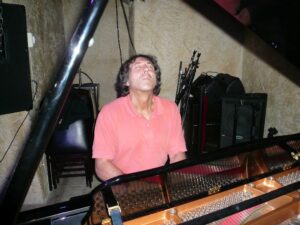
Performing at St. George Winery in Mohegan Lake, NY
The best analogy I can give is to that of Michael Jordan crossing half court dribbling the basketball and sizing up the defense. I always imagined him thinking to himself, ‘Okay, what am I going to CREATE now?’ The existing defense gives him a starting point like the existing sounds or silence that precedes my improvised solo does for me. For him, there is driving through everyone and scoring, pulling back and shooting long, any number of passes, give and goes, trying to draw fouls, etc. For my approach as an improvising artist, I don’t want to copy any of the past greats despite having studied them. For me, anything and everything is possible utilizing the formal tools and vocabulary given in music as well as any other tools conceived of “outside the box”. It may not sound like what people are expecting to hear or accustomed to hear, but that way it always sounds fresh, unpredictable, engaging and unique.
 In his first year of college, at the University of Miami, he bought his first real guitar – a Martin D18, and worked on blues, rock and especially country rock. The next year, he transferred to Kent State University, where he became very interested in jazz after hearing records by John Coltrane, Cecil Taylor, Oscar Peterson, Chick Corea, Pharoah Sanders, John McLaughlin, Larry Coryell and others. Being primarily a classically trained painter, Mr. Jones decided to attempt to translate his abstract visual stylings into sound on both piano and electric guitar. While still at Kent State, he formed the Cleveland Art Ensemble with some friends and other musicians to perform works by Keith Jarrett, Herbie Hancock, Miles Davis, Larry Coryell, Joe Farrell and his own originals. He continued to teach himself piano, guitar, arranging, and also studied Indian ragas and African rhythms.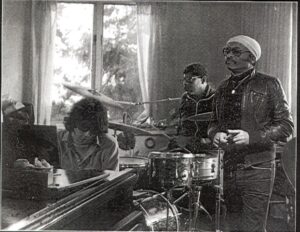
 The following year, Mark moved back to Cleveland and studied classical piano with the Lithuanian virtuoso Antanas Smetona, while he was also writing quite a bit of jazz and classical music. He, roommate Jeff Stewart and saxophone virtuoso Phil Capone had a jazz workshop in their living room, even holding big band jam sessions. Mark was commissioned to write a Prelude and Fugue for Woodwind Quartet and Men’s Choir by Case Western Reserve University, and it was performed to much acclaim in Cleveland. In 1980, Mark had the opportunity to study with Cecil Taylor and his band at the Creative Music Studio in Woodstock, NY. Mark performed one of Cecil’s works on piano with an orchestra, and was pictured with Cecil in Downbeat Magazine. Six months later, he gave a solo piano performance at Spaces in downtown Cleveland, which was recorded and later transferred to CD.
Shortly thereafter, Jones moved back to New York in order to study with Sal Mosca, one of the most accomplished jazz pianists and educators in the world who had been regarded as Lennie Tristano’s successor. Mark studied with Sal for 7 years, while concurrently studying conducting, orchestration and classical piano at the Westchester Conservatory in White Plains.
The following year, Mark moved back to Cleveland and studied classical piano with the Lithuanian virtuoso Antanas Smetona, while he was also writing quite a bit of jazz and classical music. He, roommate Jeff Stewart and saxophone virtuoso Phil Capone had a jazz workshop in their living room, even holding big band jam sessions. Mark was commissioned to write a Prelude and Fugue for Woodwind Quartet and Men’s Choir by Case Western Reserve University, and it was performed to much acclaim in Cleveland. In 1980, Mark had the opportunity to study with Cecil Taylor and his band at the Creative Music Studio in Woodstock, NY. Mark performed one of Cecil’s works on piano with an orchestra, and was pictured with Cecil in Downbeat Magazine. Six months later, he gave a solo piano performance at Spaces in downtown Cleveland, which was recorded and later transferred to CD.
Shortly thereafter, Jones moved back to New York in order to study with Sal Mosca, one of the most accomplished jazz pianists and educators in the world who had been regarded as Lennie Tristano’s successor. Mark studied with Sal for 7 years, while concurrently studying conducting, orchestration and classical piano at the Westchester Conservatory in White Plains.
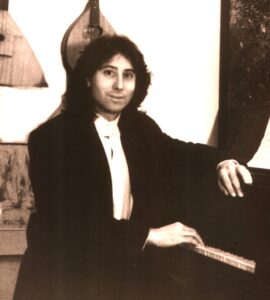 Around that time, he also formed his first version of his band, Sound Sculpture, with Kevin Hart on drums and Matthew Petterson on bass which was formed in order to perform Mark’s original compositions. They played a few gigs and Mark also played several piano/bass duets with a number of bass players at Dudley’s in Ossining. He also had his Quartet for Oboe, Two French Horns and Cello performed in New York City.
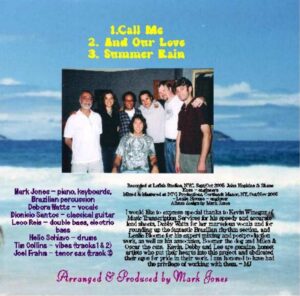 In 2005, Mark began his BossAmerioca project, an attempt to record American and English tunes from the 60’s that had been influenced by the Brazilian bossa nova craze, and to perform them in a pure Brazilian bossa nova style. The EP was recorded with featured vocalist Debby Santos Watts and it was widely praised by some of the originators of bossa nova, such as Roberto Menescal, Marcos Valle, Carlos Lyra, Cesar Machado, the music director for Maria Creuza, and Carlos Afonso, the director of Toca do Vinicius, the major bossa nova record store and museum in Rio.
 “For me, music is the arrangement of sounds or, as John Cage put it, ‘noise’ in such a way as to make it interesting and engaging to listen to. For it to succeed, there first needs to be a balance somewhere between absolute unity, such as white noise or a dial tone, and absolute variety, such as the cacophonous sounds you’d hear on a New York City street – jackhammers, car horns, motorcycles & cars & busses, voices, airplanes, etc. Either extreme or veering close to it is uninteresting to most ears. This balance needs to be developed both in written composition and improvised composition.
 My approach to written composition, whether in the so-called classical vein or jazz or rock vein is that it should have a beginning, middle development and end and should be interesting to listen to. It needs to contain enough melodic or rhythmic motifs along with tension and resolution to keep the listener interested. A jazz tune should not just be a platform to demonstrate how complex you learned to write exercises in complex, shifting time signatures at a music conservatory, but should rather be something a listener can walk away with the melody still kicking around in their head, the way tunes by Miles, Coltrane, Shorter, Ornette, Gershwin, Cole Porter, Jobim, Lennon & McCartney, Rogers and Hart, Bacharach and others did. It should be always fun to listen to and should stand the test of time.
 My approach to improvisation comes from my background as a visual artist, loosely defined in the abstract expressionist style. Rather than play a collection of ‘lick cliches’ like most jazz players, I look at the keyboard as a blank, white canvas where anything can happen. I react to whatever sounds my hands produce with no preconceptions – the only rule being to maintain contact with what is being produced and form it into a cogent narrative. There are figuratively speaking, an infinite amount of tools at my disposal, but what is used and how are not known until they are used. Silence is one of the most overlooked tools. Also, in painting, the critic Harold Rosenberg coined the term ‘action painting,’ which is free-form spontaneous improvisation on the canvas.